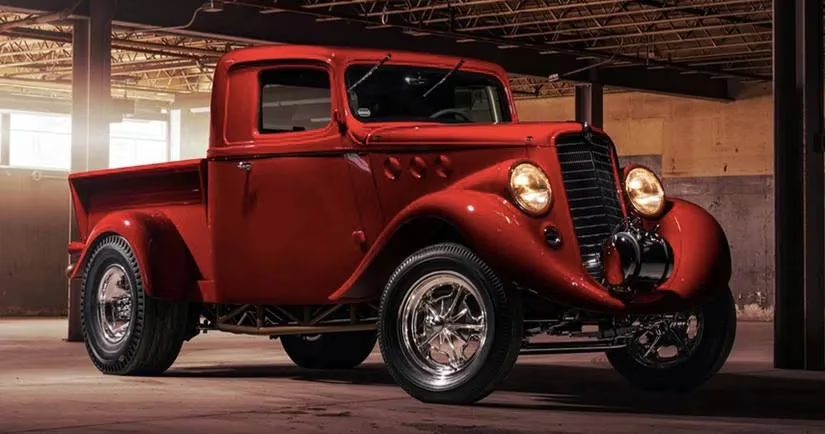
Every artist knows the agony of the final brushstroke. Painters, writers, and sculptors alike toss and turn over when to step away from the canvas. For builders of custom cars, that moment can be even more fraught—because once the clear coat hardens and the trophies are polished, the entire internet gets a vote. A perfect example still roiling the custom world in 2026 is a 1936 Willys Model 77 pickup finished in a shade of red that would look right at home on a Maranello assembly line. The truck debuted at the Grand National Roadster Show in early 2020, yet the debate over its skin deep choices burns hotter than a Hemi on a dyno pull.
The Tin Man’s Garage of Sycamore, Illinois, wrenched this restomod into existence for Ron and Vicki Ernsberger. For most of its life, the Willys hauled mail—a noble but unglamorous existence involving dented fenders and a paint job measured in ounces of rust. When the Ernsbergers decided to give the old workhorse a new identity, few would have predicted an eight-year build culminating in Rosso Mugello red, a hue cribbed from Ferrari’s palette. But that’s exactly what rolled onto the show floor, triggering a collective intake of breath. Some onlookers saw an audacious masterpiece. Others saw a tragedy of buried bare metal.
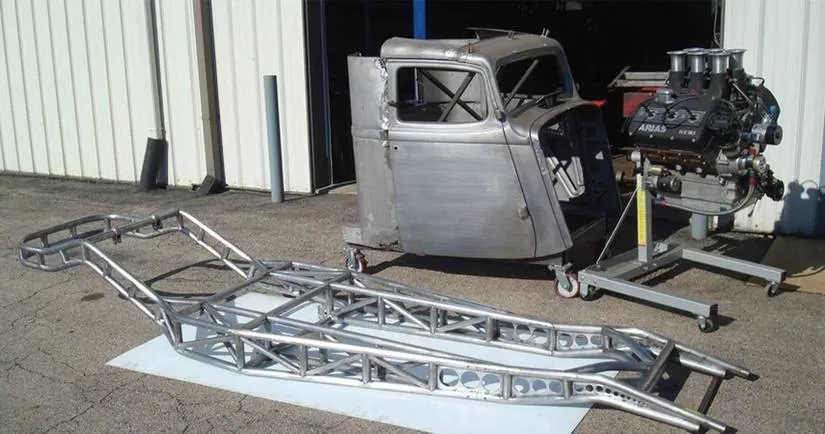
Beneath the crimson panels, the engineering is all business. A full Chromoly tube frame and chassis provide a skeleton light-years stiffer than anything Willys-Overland imagined in 1936. The heart is a 496ci Arias Hemi V6, an engine choice that raises eyebrows even among jaded hot-rodders. Mated to a Tremec TKO five-speed manual, it sends power rearward to a Dan 70 fully floating axle stuffed with 4.11 gears. Bilstein rear shocks and AFCO double-adjustable coilovers promise a ride almost as refined as the paint suggests, while Wilwood calipers clamp down at the rear. But wait—there are no front brakes. None. In a vehicle capable of felony speeds, that omission is the sort of eyebrow-raising decision usually accompanied by a shrug and a “because race truck.”
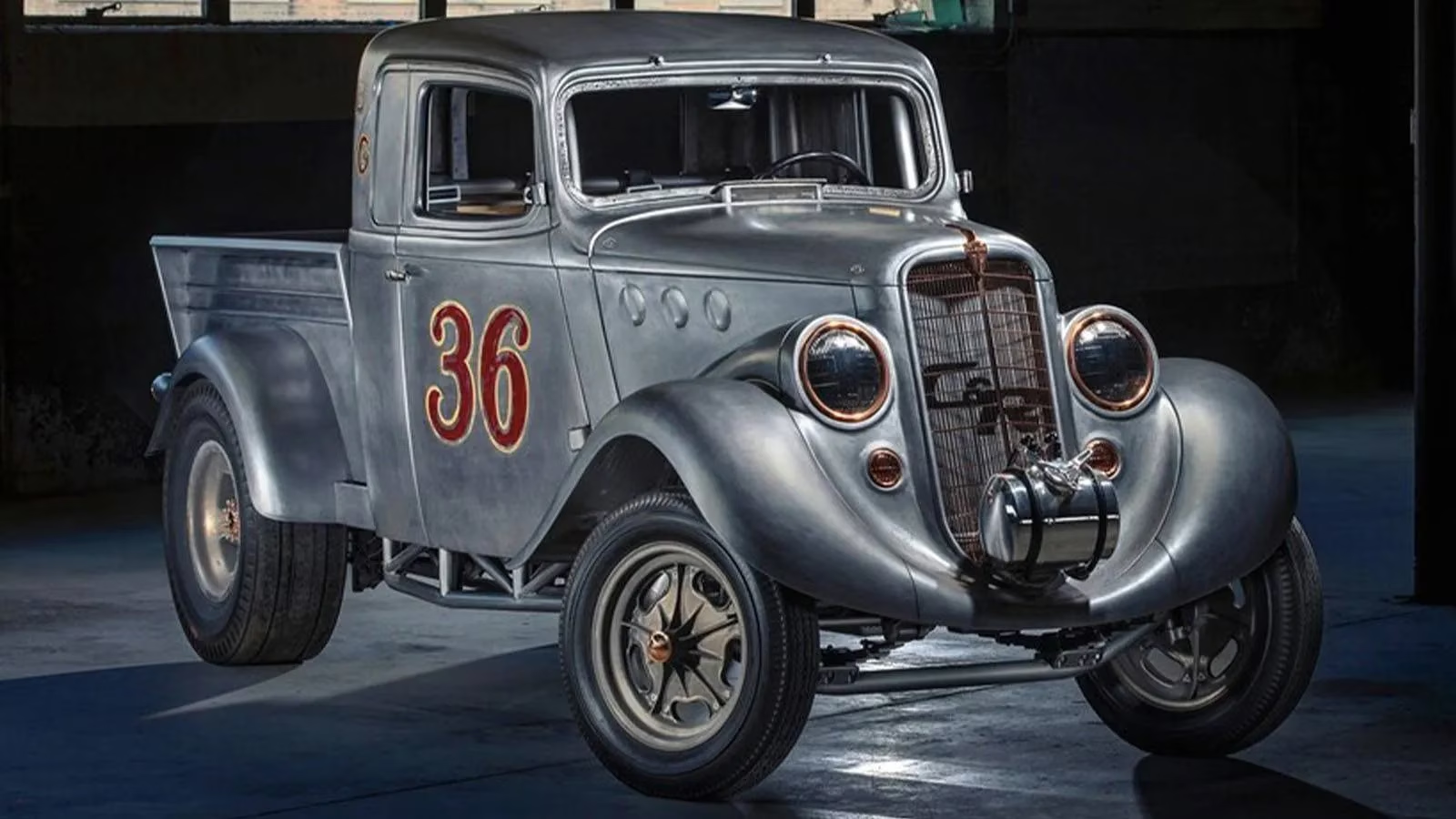
Motortrend’s original feature on the truck laid out the build in agonizing detail, and almost immediately, the comment section erupted into a philosophical war. Should a vintage hauler wear exotic Italian clothes? The \u201cpatina preservation\u201d crowd—vocal in any decade—insisted the Willys looked better during its brief moment as a bare-metal sculpture. Photos of the stripped body, circulating since 2020, only intensified the lamentations. In those images, the hand-formed steel curves seemed to whisper tales of gravel roads and pre-war grit. To cloak all that history in a finish usually reserved for a 488 Pista struck purists as borderline sacrilege.
Now cut to 2026. The Willys hasn’t retreated to a climate-controlled vault. It continues to appear at events, most recently making waves at a prominent Midwest concours where it was parked next to a sea of similarly spotless customs. The crowds still gather, and the debates still rage. Some attendees snap photos from every angle, marveling at the flawless bodywork and the audacity of the absent front binders. Others stand with arms folded, muttering about how the truck would have looked \u201cperfect\u201d in nothing but scuffed steel and a coat of matte clear. Social media threads on the subject run for hundreds of responses, proving that time does not heal all automotive wounds.
What makes this particular rig so divisive? The answer lies in its balancing act between high art and high performance. The Ernsbergers could have pursued a rat-rod aesthetic or a period-correct restoration. Instead, they chose a path that forces every spectator to confront their own biases. If a truck wears Ferrari paint but doesn\u2019t stop like one, is it a hot rod or a conceptual piece? If the builder leaves off front brakes for clean looks but engineers a top-tier rear suspension, is it genius or madness? The build sheet reads like a manifesto: 496ci Hemi V6 with Arias internals, TKO five-speed stick, Dan 70 rear, Bilstein shocks, AFCO coilovers, and Wilwood rear discs. And, again, zilch up front. That alone guarantees the Willys gets talked about.
In a world where custom perfection often means complete predictability, the Tin Man\u2019s Garage creation remains a glorious outlier. It rejects the notion that a truck must be an either/or proposition—restoration or restomod, shiny or raw, sensible or scary. The Willys is all of those things simultaneously, wrapped in a color that would make Enzo himself squint. As the 2026 show season marches on, the little pickup continues to do what great art does: it refuses to let anyone be indifferent.
Ultimately, the Hemi V6 Willys is a rolling reminder that taste is personal, and that finishing a build is more about courage than consensus. After all, anyone can preserve history. It takes a special kind of crazy to cover it in Italian red, delete the front stoppers, and dare the world to keep its mouth shut.
As conversations around the Willys and its audacious design continue to unfold, it's worth considering how the choices made by builders reflect broader trends in automotive customization. With the increasing popularity of mixing high-performance components with unique aesthetics, enthusiasts are often left navigating a landscape where costs can vary significantly depending on the rarity and quality of parts. For those looking to embark on their own distinctive projects or simply seeking to understand the financial aspect of such endeavors, researching and comparing prices is crucial.
Whether you're diving into a restoration or crafting a one-of-a-kind masterpiece, having access to reliable information about component costs can be a game-changer. DealNest offers a platform where you can compare prices here, helping you make informed decisions that fit your budget and vision. By utilizing resources like DealNest, builders can ensure they balance their creative ambitions with practical considerations, making their automotive dreams a reality without breaking the bank.
Comments