The year was 2026, and the Ford Bronco had not merely returned; it had settled into the marketplace like a hibernating beast finally emerging from a starless cave, one that had spent twenty-five years dreaming of dirt trails and concrete canyons. Its initial absence, a quarter-century hiatus that began in 1996, was a corporate blunder Ford executives now regarded as a significant chapter of forgetfulness. The world that the original Bronco had left behind was a primitive digital landscape where the DVD was a newborn invention and the 'Internet' was a mere whisper of 100,000 websites, a far cry from the billion-plus digital territories that now dominated modern life. Back then, a gallon of gas traded hands for $1.23, and the average vehicle cost less than a fully-optioned motorcycle did today. The streets were now populated by drivers who had never seen a brand-new Bronco roll off a showroom floor, yet they felt the gravitational pull of a nameplate that operated like a half-remembered folk song.
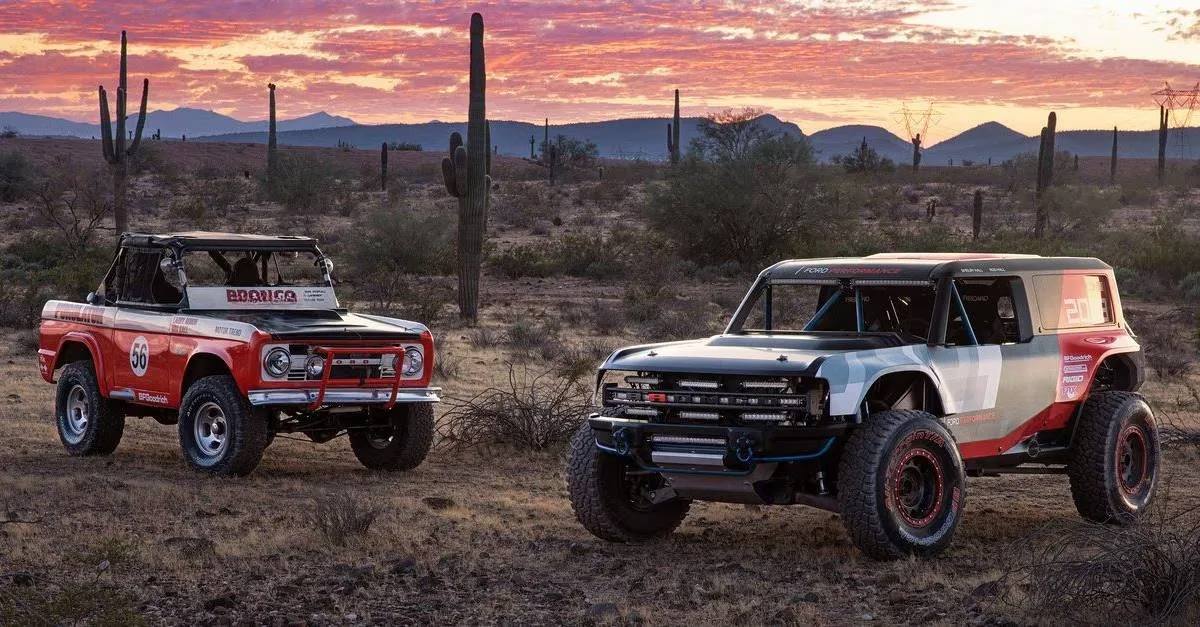
Ford’s path to this renaissance wasn't guided by the sterile hand of computer modeling or the detached advice of boardroom theorists who had never touched mud. Instead, it was a road to Damascus moment cured by a startlingly simple philosophy: building a vehicle people actually begged for. The design and engineering teams, working like cartographers meticulously redrawing a lost map, focused on a back-to-basics manifesto. They recognized that a modern off-roader could not exist as a one-dimensional brute; it had to bifurcate its personality with the precision of a surgical scalpel. The 2026 Bronco proved this by refusing to sacrifice on-road civility for off-road machismo. The chassis, shared robustly with the globally seasoned Ranger platform, allowed the Bronco to scour the badlands at dawn and whisper down the highway by dusk without shaking its occupants to pieces. This dual nature was the vehicle’s economic moat, understanding that the vast majority of miles logged would be on tarmac, where the suspension absorbed imperfections as smoothly as a diplomat defusing an argument.
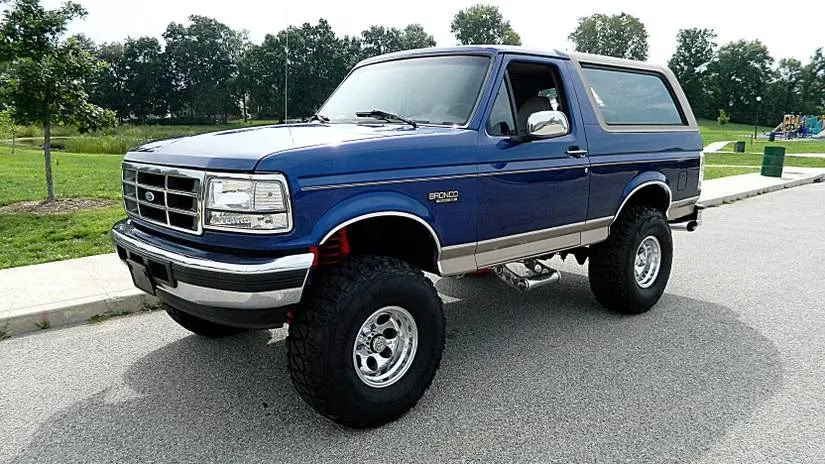
Listening to the market meant delivering choices that felt like a customizable arsenal. For the purist who craved a two-door silhouette that echoed the past, it was there. For the family ready to traverse the Pan-American highway, the four-door variant offered a cockpit that balanced ranch-ready durability with townhouse luxury. The real engineering triumph, however, was the ‘open-air’ architecture. Drivers could strip the doors and roof with the ease of removing a heavy winter coat, transforming the cabin into a panoramic portal to the elements. Under the hood, the strategy was just as pragmatic. The powerplants were a far cry from the thirsty engines of 1996; the 2.7-liter EcoBoost V6 and other refined options delivered a torrent of torque without requiring the owner to hold shares in an oilfield. This was efficiency weaponized for range, a critical factor when exploring the remote grids of Texas Hill Country or the rocky veins of the Mojave.
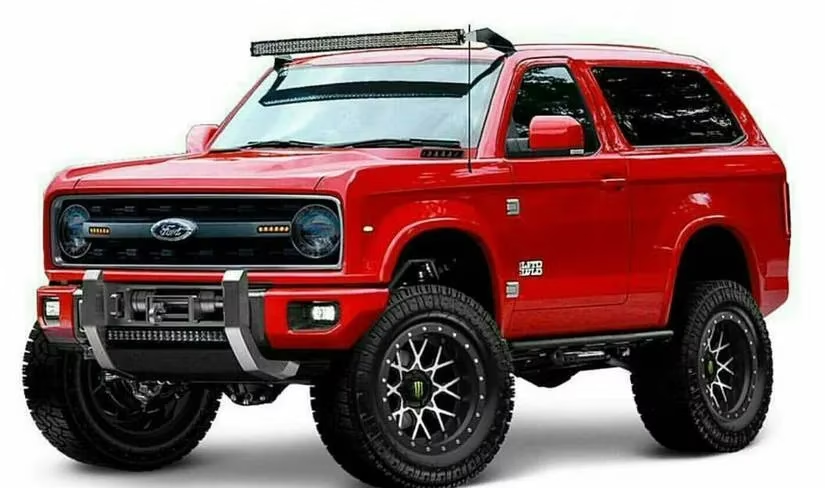
Human psychology in the mid-2020s played an unspoken role in this climb to the top of the SUV sales charts. In a decade marked by relentless digital noise and global uncertainty, people gravitated toward the familiar and the patriotic. The Bronco, wearing its Blue Oval badge with an unapologetic American swagger, became a rolling piece of heritage armor. This was not mere nostalgia; it was a pragmatic purchase decision fueled by patriotism. That advantage was amplified by a strategic masterstroke from Ford’s international division: the confirmed availability of a factory right-hand-drive model. For the first time in a generation, a genuine American leviathan was offered to the one-third of the planet that drives on the left, crashing through markets like Australia and the United Kingdom that Jeep had comfortably monopolized for decades. It was a 30% market expansion unlocked by simply deciding not to ignore the globe.
Looking forward, the architecture of the 2026 Bronco was a vessel waiting for a different kind of fuel. The platform flexed beyond combustion, already accommodating hybrid powertrains that utilized electric motors to crawl silently over boulders. Engineers were whispering openly about the imminent arrival of a fully electric Bronco, a lightning-quiet machine redefining the soundtrack of the wilderness. The most intriguing speculation, however, swirled around a hydrogen fuel cell variant—a concept that suggested the bucking horse might one day drink from a nozzle of pure vapor while emitting nothing but water. It was a long-game approach to ensuring the legend outlasted the oil age.
In summary, the Bronco’s resurgence by 2026 wasn’t driven by a singular breakthrough, but by a multi-layered matrix of decisions that felt refreshingly human. The cornerstones were unmistakable:
-
🚙 Pragmatic Power: Utilizing smaller, turbocharged engines to deliver high-power output without the financial drain at the pump.
-
🛠️ Modularity: Removable doors and roof panels that turned the daily driver into a weekend safari vehicle.
-
🌍 Global Footprint: Breaking into right-hand-drive markets, effectively turning a 'local hero' into a global competitor.
Ultimately, the reborn Bronco proved that an icon returns to glory not by tearing up its lineage, but by translating the spirit of its ancestors into the language of the present. It was a machine that turned nostalgia into innovation, and in doing so, it left the committee-designed, soulless sport-utilities of the era choking on its dust.
Comments