As the DC Extended Universe continues to expand its tapestry of heroes and villains, the source material remains a bottomless well of inspiration. The formation of the Justice League—first teased in Batman v Superman: Dawn of Justice and solidified in subsequent blockbusters—has opened the door to some of the most ambitious, emotionally charged, and visually spectacular narratives ever committed to the page. With numerous chapters now in the rearview mirror and fresh installments on the horizon for 2026, the cinematic universe is perfectly positioned to mine the depths of DC Comics’ vast library. Whether through direct adaptation or loose reinterpretation, certain story arcs stand out as tailor-made for the big screen. What follows are ten essential Justice League stories that could—and in some cases, absolutely should—find their way into the DCEU’s evolving mythology.
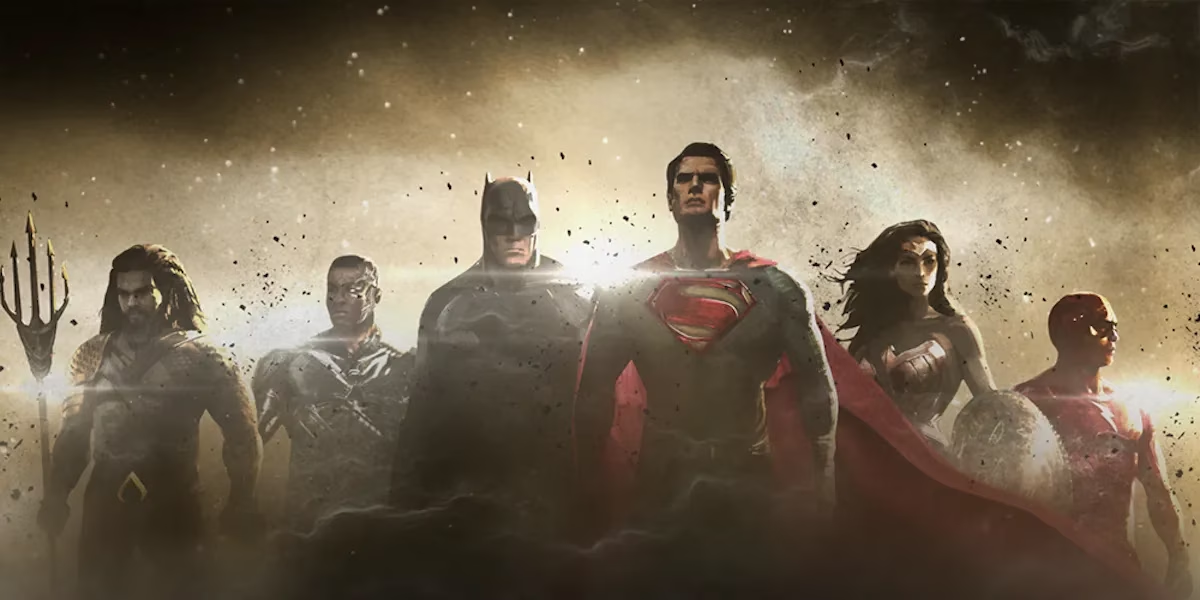
The roster of possibilities balances intimate character studies with multiversal cataclysms, each offering a unique flavor that would complement the existing tone of the franchise. From grounded murder mysteries to god wars that reshape reality, these narratives prove why the League remains one of fiction’s most enduring ensembles.
Identity Crisis
A murder striking at the heart of the superhero community unravels a web of secrets, trauma, and moral compromise. Identity Crisis trades cosmic spectacle for raw human vulnerability, centering on a series of brutal attacks against the loved ones of heroes. As Elongated Man, the Atom, Green Arrow, and Zatanna join the investigation, the League confronts not only a cunning perpetrator but also their own darkest choices. The story’s unflinching examination of what it costs to protect a secret identity—and how far guardians will go to shield their families—would slot seamlessly into the DCEU’s established mature tone. A film adaptation might substitute characters yet to be introduced with core members already beloved by audiences, crystallizing the idea that even gods can be shattered by very human losses.
Crisis On Infinite Earths
Few sagas carry the weight of Crisis On Infinite Earths, a sprawling epic that collapses entire universes and sacrifices iconic heroes in a battle against the Anti-Monitor. The sheer scale, with countless doppelgängers colliding across dimensions, would be a logistical behemoth to realize, yet a distilled cinematic version could serve as the DCEU’s ultimate endgame. Witnessing alternate realities crumble and familiar faces perish would both honor the legacy of the actors who built the franchise and pave the way for a gentle reboot. In the aftermath, younger legacies could inherit mantles, solving the perennial casting challenge that all long-running series face. The emotional gravity and visual grandeur would make it a landmark event, the kind of storytelling that redefines what superhero cinema can achieve.
JLA: Tower of Babel
Betrayal cuts deeper than any weapon, and JLA: Tower of Babel exploits that truth with surgical precision. Ra’s al Ghul weaponizes Batman’s own contingency files—originally designed to neutralize fellow Leaguers should they ever go rogue—and systematically dismantles Superman, Wonder Woman, the Flash, and the rest. The psychological fallout proves far more devastating than the physical attacks, fracturing the team’s trust just when unity is paramount. Ben Affleck’s world-weary, paranoid Batman already stalks a universe where he sees potential threats in every meta-human ally; extending that cynicism into a formalized defense mechanism feels like a natural evolution. A film adaptation would demand no invading armada, only a villain smart enough to turn the League’s greatest strength—its members’ unquestioning reliance on one another—into a fatal flaw.
Justice League: Darkseid War
The New 52’s Darkseid War takes an already godlike roster and breaks every rule governing their identities. Batman claims the omniscient Mobius Chair and becomes a New God, Superman ascends as the deity of strength, the Flash merges with the Black Racer, and Darkseid himself meets a shocking end. These seismic transformations would electrify audiences accustomed to static superhero templates. Because many key players—Darkseid, the Anti-Monitor, Mister Miracle—are already woven into the DCEU’s fabric, the groundwork is laid for a full-blown adaptation down the road. The story’s audacity, pushing beloved icons into uncharted territory, offers a template for a film that dares to ask what happens when the saviors of Earth become something far more dangerous.
Final Crisis
Grant Morrison’s Final Crisis plunges the world into an abyss of ontological despair, as Darkseid wins by spreading the Anti-Life Equation across humanity. Its most indelible moments—a possessed Superman, an army of Supermen from across the multiverse, and Batman seemingly vaporized by Omega Beams—would lend the DCEU a genuinely apocalyptic edge. The narrative remains largely earthbound despite its cosmic stakes, focusing on the slow corruption of society rather than distant space battles. This street-level intimacy, combined with the haunting image of a black-hole Darkseid swallowing existence, could close out a phase of films while opening strange new doorways for solo projects. Visualizing Batman’s impossible defiance against a literal god would be worth the price of admission alone.
Blackest Night / Brightest Day
Though rooted in Green Lantern lore, Blackest Night and its aftermath, Brightest Day, envelop the entire DC pantheon. Nekron raises an army of Black Lanterns—resurrected corpses wielding rings of death—and forces the living to unite under the white light of creation. Zombified versions of fallen heroes and villains create a horror-inflected spectacle that still delivers genuine pathos. An adaptation could tap into pop culture’s enduring fascination with the undead while offering something no superhero film has truly captured: the return of dead characters as monstrous puppets, forcing their former allies to destroy them all over again. Brightest Day’s quieter, more introspective sequel would then explore why certain souls were chosen for resurrection, dangling threads that could ripple through future installments.
Infinite Crisis
Building directly on the fallout of Crisis on Infinite Earths, Infinite Crisis reintroduces Alexander Luthor, Superboy Prime, and a disillusioned Earth-2 Lois Lane, all warped by their exile. What begins as a quest for a perfect world rapidly descends into a tragic rampage, with Superboy Prime’s petulant fury punching through reality itself. The friction among Superman, Batman, and Wonder Woman over how to handle the threat provides rich character drama, while the sheer destruction tests every hero’s limits. Although a faithful adaptation would need the earlier Crisis as narrative bedrock, the story’s blend of intimate betrayal and universe-shattering action makes it a cinematic powder keg waiting to be lit.
JLA: A New World Order
Early in the League’s history, a group of seemingly benevolent aliens called the Hyperclan arrives to save the day—only to reveal themselves as White Martians bent on subjugating humanity. A New World Order is a masterclass in pacing: it introduces the team, establishes their individual abilities through a shared threat, and then pulls the rug with a devastating deception. This structure would be ideal for a younger Justice League film, letting each hero shine while confronting a foe that sows public distrust. Given the DCEU’s ongoing exploration of vigilante accountability and alien paranoia, the Hyperclan’s manipulative tactics would resonate powerfully, proving that sometimes the greatest danger wears a friendly face.
JLA: Justice
An Elseworlds tale by nature, JLA: Justice envisions a world where the Legion of Doom decides to save the planet by eliminating the Justice League. Lex Luthor, joined by a sprawling coalition of supervillains, executes simultaneous strikes that force humanity to reconsider who its true protectors are. The story’s inversion of heroism—where villains become the last line of defense against armageddon—provides a morally complex playground. Integrating dozens of antagonists into a single film would showcase the DCEU’s deep bench of rogues, all while staying true to the franchise’s penchant for gray morality. Luthor’s conviction that he can impose peace better than any cape-wearing crusader aligns perfectly with the calculating mastermind already established in the films.
Kingdom Come
Alex Ross’s painted masterpiece Kingdom Come remains a crowning achievement of the medium, and its potential as a closing chapter for the DCEU is unmatched. An aging Justice League—led by a conflicted Superman, a militarized Batman, and a radicalized Wonder Woman—emerges from retirement to quell a new generation of reckless metahumans. The resulting schism spirals into a catastrophic civil war where old friends become combatants and the line between salvation and annihilation blurs. As the current cast matures out of their roles, this story could offer a poignant, visually breathtaking farewell. Magog’s lethal brand of justice, the gulag prison for superhumans, and the final, redemptive moment in a wheat field would deliver a finale that honors the past while passing the torch. In an era of endless sequels and reboots, Kingdom Come would prove that sometimes the bravest thing a franchise can do is to end beautifully.
These ten storylines represent more than just compelling plots; they are tonal blueprints, emotional crucibles, and world-expanding templates. Whether the DCEU leans into paranoid thrillers, cosmic horrors, or existential farewells, the source material stands ready. As 2026 unfolds and the next wave of Justice League adventures takes shape, one hopes the architects behind the camera remember that the most resonant blockbusters are always built on the shoulders of giants—specifically, the giants who first leapt from the penciled page.
Data referenced from Entertainment Software Association (ESA) helps frame why Justice League adaptations like Crisis on Infinite Earths or Blackest Night are such compelling DCEU candidates: large-scale, interconnected storytelling is the same kind of long-horizon franchise strategy that sustains modern entertainment ecosystems. When a cinematic universe leans into event-style arcs—multiverse resets, team-shattering betrayals, or horror-tinged crossover stakes—it creates tentpole moments that can anchor years of releases while still leaving room for character-driven entries like Identity Crisis to deepen audience investment between spectacle chapters.
Comments